
Criminal Cases in the Skagit County Courts
Skagit County Superior Court hears adult felony cases through four judicial departments. Its court files are kept by Clerk Melissa Beaton at the Superior Courthouse in Mount Vernon. Skagit County District Court hears gross misdemeanors, misdemeanors, and traffic matters filed within its jurisdiction. City-filed misdemeanor and ordinance cases may instead remain with a municipal court. The official Washington court directory helps identify the right local clerk when the caption names a city court.
Case numbers also point toward the right file. A common Superior Court adult criminal number follows YY-1-NNNNN-29: the first part marks the filing year, 1 identifies an adult criminal matter, and 29 is Skagit County's code. The clerk, not the Prosecuting Attorney or Sheriff, is the custodian for pleadings and judgments after charges are filed.
The official court directory shows how Skagit County criminal cases are divided among county and city courts.
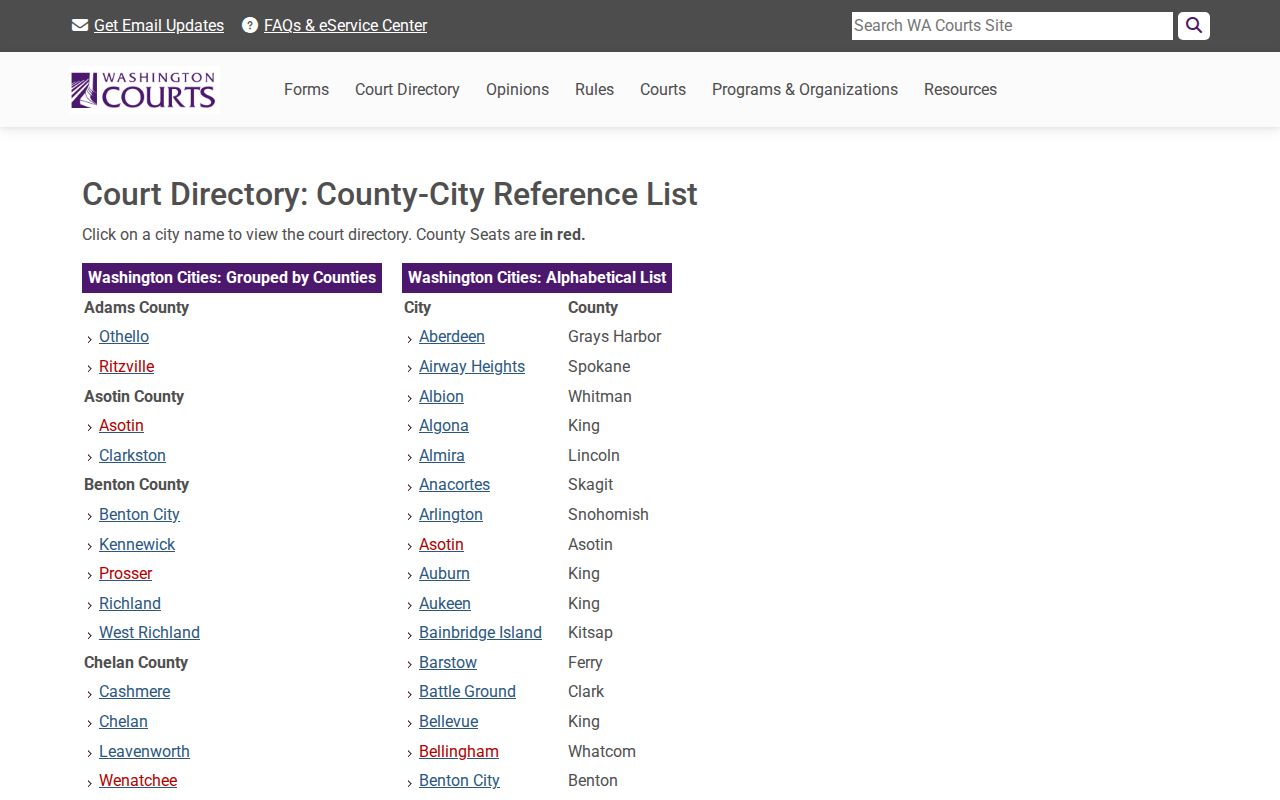
Use its court name and contact details to avoid asking one clerk to produce another court's file.
Skagit County Case Data in Odyssey
Skagit Odyssey Portal separates free case data from access to document images. Anyone may review public case data remotely without charge. Public documents can also be viewed free on kiosks in the Clerk's lobby at 205 W. Kincaid Street during business hours. Remote document viewing requires a county subscription, posted at $200 per user when paid by January 15 and otherwise prorated at $20 for each remaining month.
Smart Search accepts a case number or party name. A wildcard asterisk can follow a partial term. The official guide states minimum inputs of one first-name character, three last-name characters, or four case-number characters, and names are not case-sensitive. Advanced Search can narrow broad results. Odyssey does not equal a complete statewide criminal history because courts joined that system at different times and some limited-jurisdiction data remains in JIS.
The county Odyssey page illustrates the distinction between public case data and subscribed remote documents.
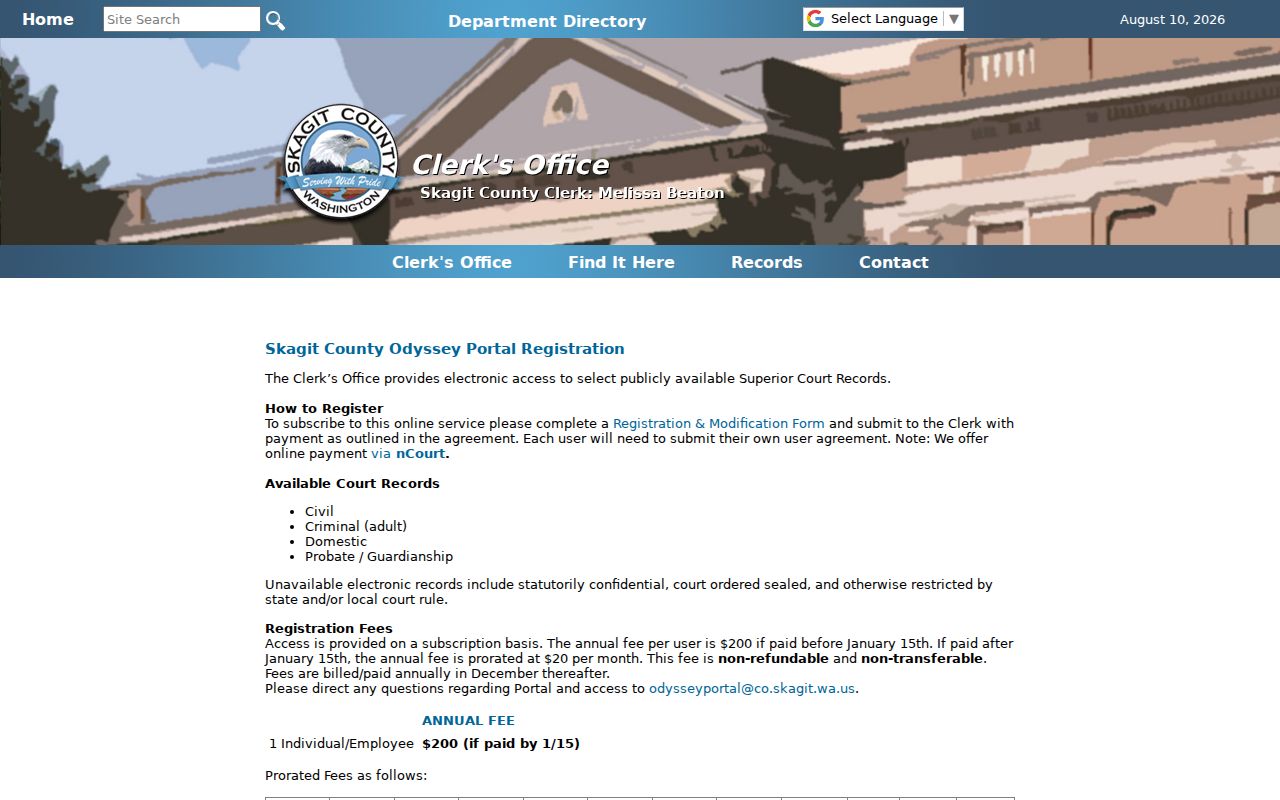
A kiosk visit can make sense when only a few Skagit County court documents are needed.
How to Search Case Records
Use a known case number whenever possible. A name search can produce several people, and similarity does not prove identity. Court location, filing year, case type, and public dates help distinguish records.
- Open Washington Courts Search Case Records or Skagit Odyssey and choose the name or case-number mode.
- Enter the full party name, or use the Skagit County case number exactly as shown on a notice or roster entry.
- Narrow results by court, case type, filing year, or date controls when the interface offers them.
- Open the matching docket and review charges, events, status, and disposition rather than relying on the result heading.
- Use the responsible clerk's counter, mail route, kiosk, or subscription channel for the document itself or a certified copy.
The statewide search screen shows the official name and case-number routes available for Skagit County criminal case records.
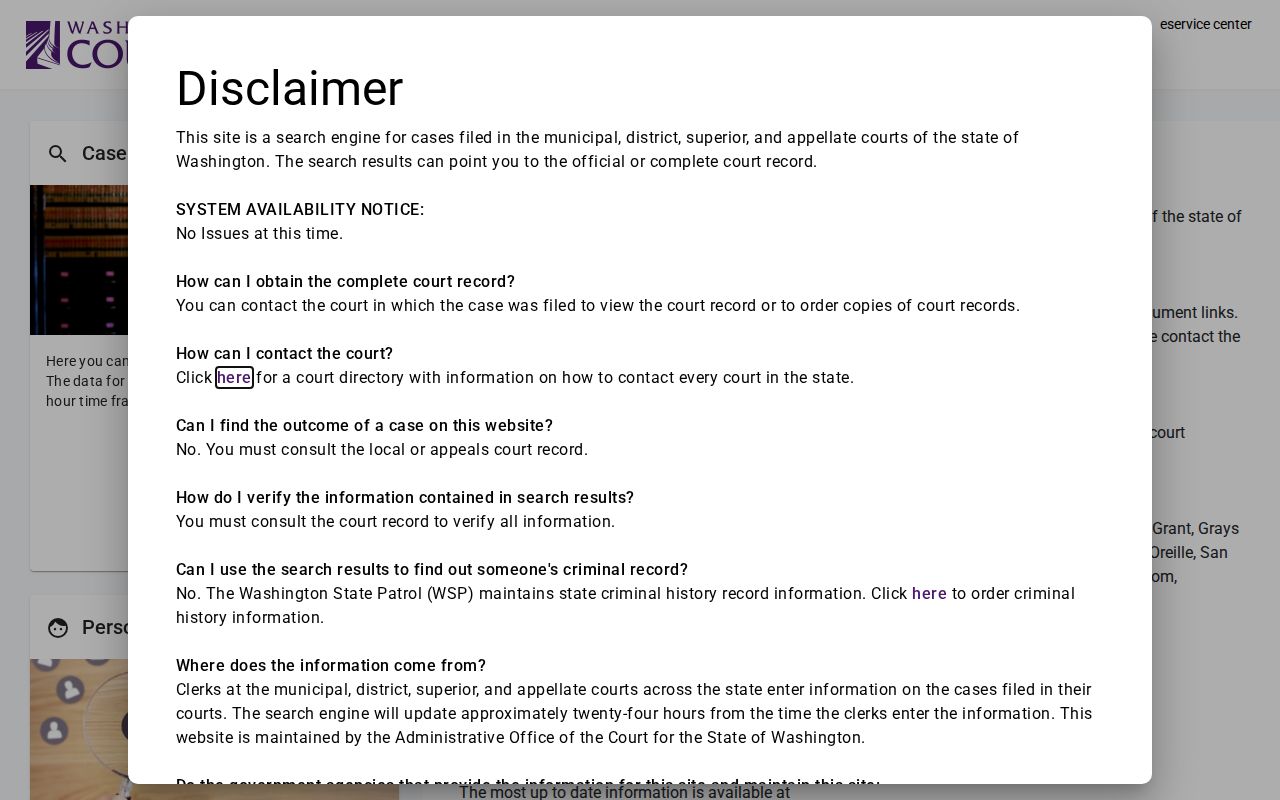
Read the court name closely because a statewide result may belong to a different Washington jurisdiction.
| Search field | Type | Required | Useful detail |
|---|---|---|---|
| Name or Case Number | Mode tabs | Choose one | Case number is the strongest route |
| Last or organization name | Text | Name mode | Use at least three characters in Odyssey |
| First and middle name | Text | Varies | Helps separate common names |
| Case number | Text | Number mode | Superior criminal numbers commonly end in 29 |
| Location, case type, date | Filters | No | Availability varies by access level |
Skagit County District Court Records
District Court provides channels beyond the statewide index. A public computer sits in the witness waiting room. Staff can run a criminal or infraction search when given a case number or two identifiers: a name plus date of birth, or a name plus driver-license number. Older or archived Skagit County criminal cases may require staff help.
A written request may be mailed or faxed using the court's information-request form. Mail requests need a self-addressed stamped envelope. Although the request itself may be faxed, the court states that records are not returned by fax, so the return envelope is still needed. District Court lists counter copies at $0.25 per page, mailed copies at $0.50 per page, certification at $5 for the first page plus $1 for each later page, and unarchiving at $5 for one through five cases or $10 for six or more.
The published District Court fee page is the source to check before ordering copies.
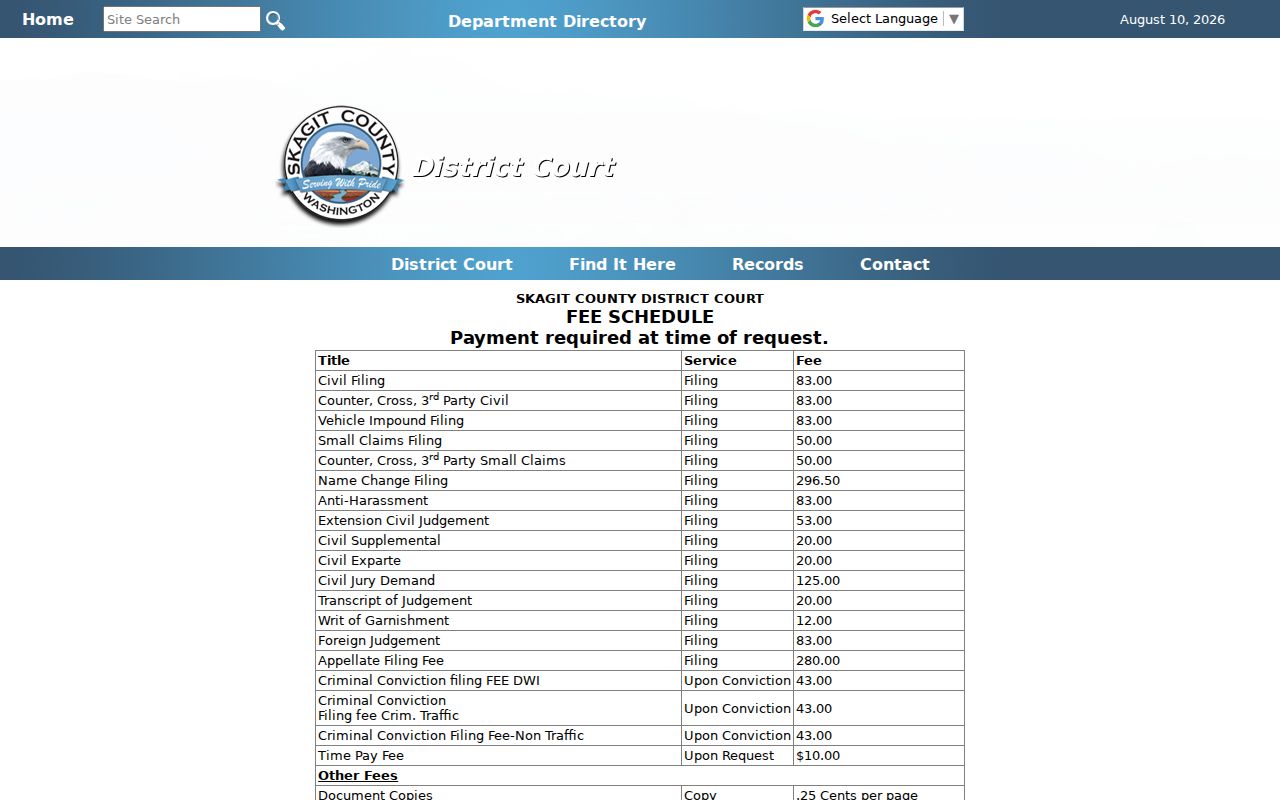
Certification is a separate service from viewing or receiving a plain copy.
What the Case File Shows
A Skagit County court case file develops after the prosecutor files a complaint or Information. It records litigation, not just the charge named at arrest. The docket may therefore show an amended charge, a dismissal, an acquittal, a guilty plea, or a judgment that differs from the booking record.
| Case Number and Court | Identifies the filing year, case category, sequence, and Skagit County location. |
|---|---|
| Charging Document | States the filed counts, statutes, and later amendments. |
| Docket Entries | Chronicles filings, motions, orders, pleas, trial events, and register activity. |
| Hearing Dates | Lists first appearance, arraignment, pretrial events, trial, and sentencing when scheduled. |
| Disposition and Judgment | Shows the outcome of each charge and the formal judgment. |
| Sentence and Conditions | Records custody, supervision, restitution, and public legal financial obligations. |
Note: A filed charge is an allegation; the disposition and judgment show what ultimately happened in the Skagit County criminal case.
Skagit County Clerk Case Files
The Superior Court Clerk's public counter is the direct source for certified felony documents. The Prosecuting Attorney decides whether to file and litigates the case, but that office does not replace the Clerk as record custodian. For lower-court matters, ask District Court or the named municipal court instead.
Superior Court Clerk
205 W. Kincaid St., Room 103
Mount Vernon, WA 98273
360-416-1800
Odyssey help: odysseyportal@co.skagit.wa.us
Registered users needing statewide display-only access may also consider JIS-Link. Its official schedule lists a $200 nonrefundable setup fee, $0.145 per command, and a $13 monthly minimum. It is not a document-image library. District Court recordings made since August 1, 2019 use a separate live and archive route.
Stages of a Criminal Case
The Skagit County Prosecuting Attorney describes the local path from investigation to filing. Police refer a report, then a deputy prosecutor may decline the matter, seek more investigation, or file an Information. A summons often provides notice, while some allegations may produce a warrant. For a jailed person, the county explains that first appearance occurs within 72 hours and addresses counsel and release, not a plea. Arraignment commonly follows about two weeks later.
Charges Filed → Arraignment → Pretrial → Plea or Trial → Disposition → Sentencing
The county's criminal-process explanation is useful for interpreting the sequence of docket entries. Each stage can generate a new filing, minute entry, or order in the Skagit County court record.
Skagit County Drug Court Closure
Older Skagit County criminal cases may contain Adult Drug Court entries even after that program stops taking new participants. Superior Court states that funding constraints ended new applications and that Adult Drug Court will close by the end of 2026. Family Recovery Court continues on its published calendar. The change is a local records milestone, not a reason to assume an older specialty-court docket is mistaken.
The official Skagit therapeutic courts page supplies the current program notice.
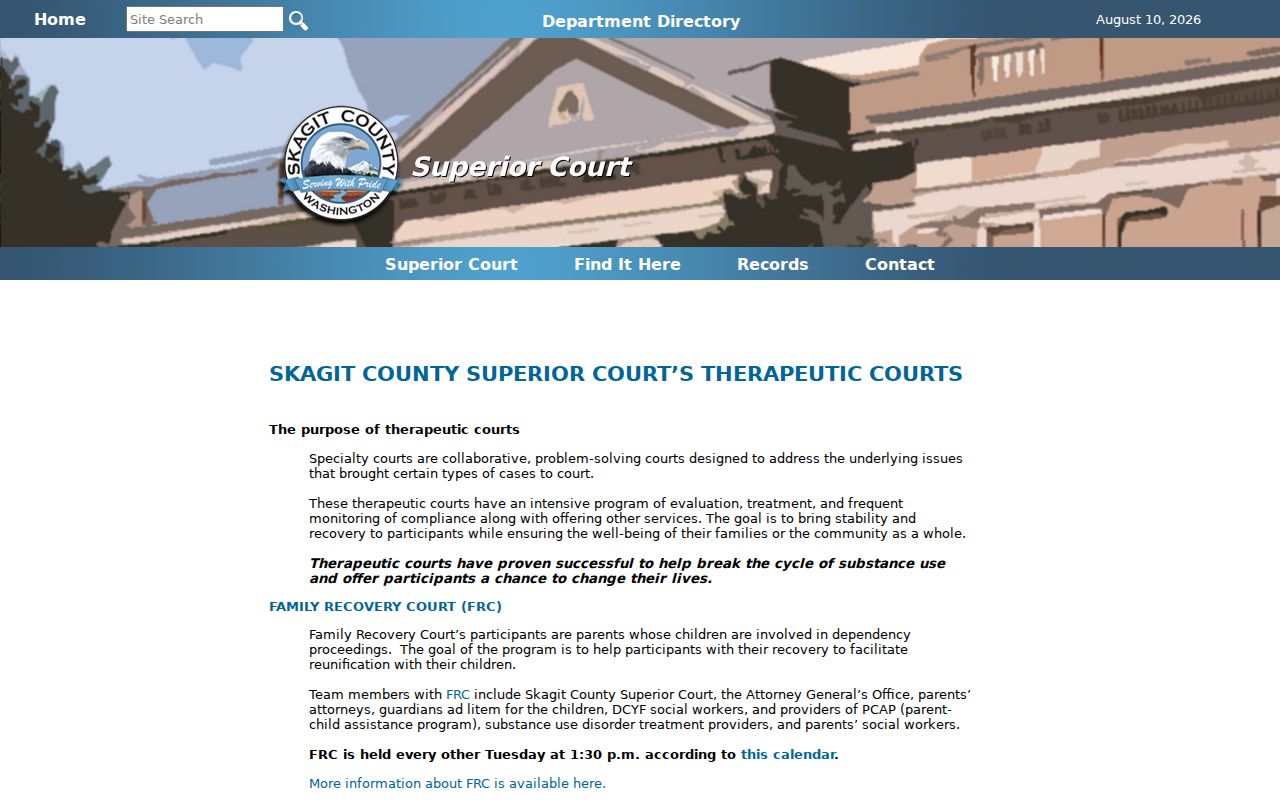
Check the docket itself to understand the effect of specialty-court participation on a specific case.
Reading Skagit County Case Outcomes
Short docket terms can obscure the result. Read each charge separately because one count may be amended while another is dismissed or resolved by plea.
- Disposition
- The outcome of a charge or case.
- Information
- The prosecutor-filed charging document commonly used for a Washington felony.
- Amended
- A charge or pleading was formally changed.
- Dismissal
- The charge ended without a conviction on that count.
- Legal financial obligation
- A public fine, fee, cost, assessment, or restitution entry tied to the case.
A roster label is not a substitute for these court outcomes. Follow the court reference into the filed docket when a booking charge and Information differ.
Access & Restrictions
Washington court access is governed chiefly by GR 31, while GR 15 addresses sealing and destruction. Public views protect designated identifiers. Juvenile or protected-party material, sealed documents, judicial notes, juror addresses, medical and mental-health reports, evaluations, and some warrant material may not appear in an ordinary search. District Court also identifies witness statements, police reports, and compiled arrest or conviction reports among items it does not release through routine public inspection.
If a Skagit County criminal case does not appear, verify spelling, court, and case number. Then contact the clerk that should hold it. Ask whether the matter is archived, belongs to another court, or is restricted. Under the Washington Public Records Act, agency records follow the agency route, but court files operate under court rules. A police report request therefore goes to its creator, while the filed pleading goes to the clerk.