
Running a Sex Offender Check in Skagit County
The Skagit County Sheriff Registered Sex Offender List is the direct local channel. It publishes kidnapping registrants, Level II registrants, Level III registrants, and qualifying Level I cases. The table can be sorted by city or surname. Each listed name opens a public profile, while the address link opens CrimeMap. Check the “Updated” field before relying on an address because registration information can change.
The local list answers a focused Skagit County question. The National Sex Offender Public Website, or NSOPW, adds participating jurisdictions across the country. It is useful when someone recently moved or when the relevant place is near a county or state line. Neither channel should be treated as a wanted-person search. The Sheriff states that people on its list are not necessarily wanted by law enforcement.
Skagit County Registry List Controls
The Sheriff list is built for browsing as well as direct name checks. Its visible columns are Type, Name, Address, City, and Updated. City sorting helps narrow a search to Mount Vernon, Anacortes, Sedro-Woolley, or another Skagit community. Surname sorting is more useful when the exact name is known. A profile link supplies person-level details, while the separate address link provides geographic context.
The official county registry list shows how those controls appear without requiring a private search service.
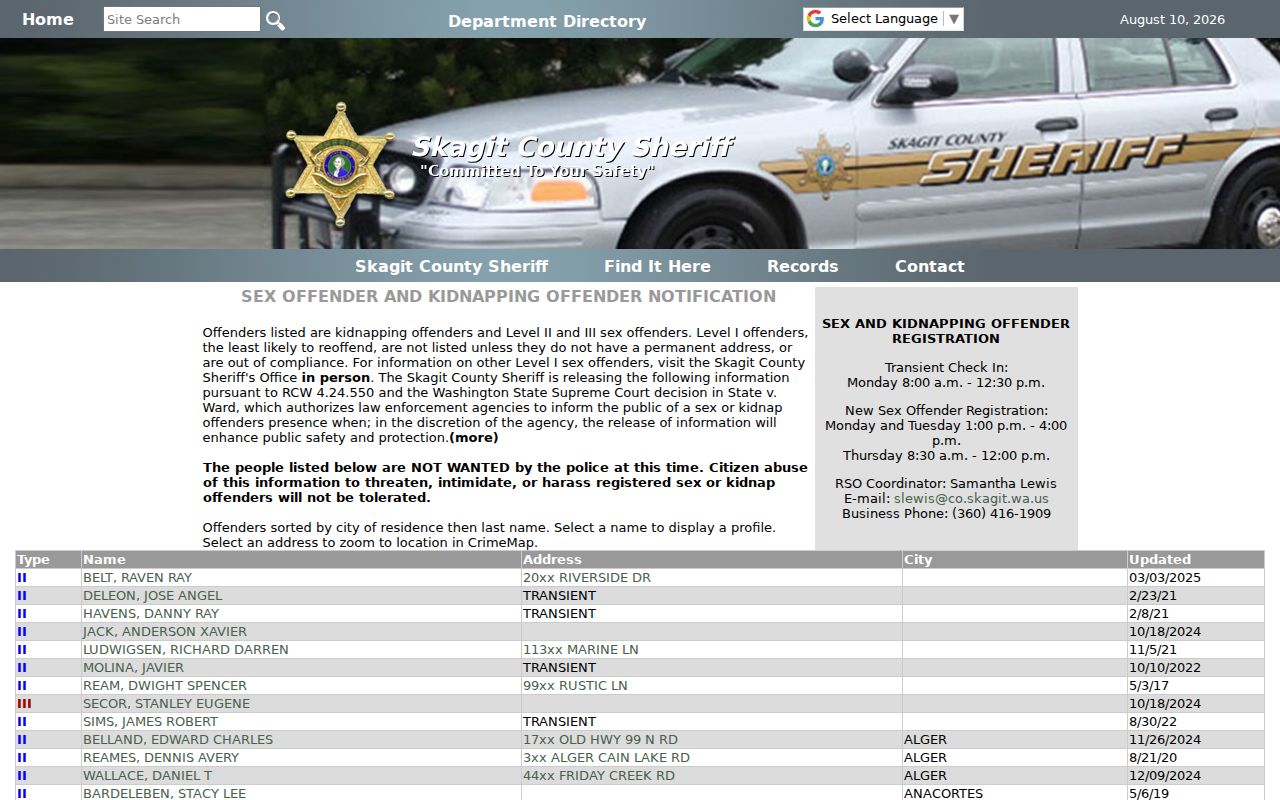
The county view keeps the public search tied to the agency that registers people locally. It also makes the profile date and city visible before a reader opens more detail.
Searching the Washington Sex Offender Public Registry
Washington implements public registry disclosure through county sheriffs under RCW 4.24.550. In Skagit County, begin with the Sheriff list for local profiles and map links. Use NSOPW for a wider geographic sweep. The two views complement each other, but the local Sheriff remains the right contact for registration questions, a suspected failure to comply, or an allowed request for Level I information.
- Open the Sheriff list and read its use warning before searching.
- Sort by surname or city, then narrow the rows using facts already known.
- Open the name profile and compare aliases, physical details, offense information, and the updated date.
- Use the address CrimeMap link for local context, or repeat the check through NSOPW when another jurisdiction may matter.
| Field Label | Type | Required | Notes |
|---|---|---|---|
| Surname | Sortable list column | No | Use when a family name is known. |
| City | Sortable list column | No | Groups published Skagit County entries by city. |
| Profile name | Link | No | Opens the public person profile. |
| Address | CrimeMap link | No | Opens the mapped address context supplied by the county. |
| NSOPW location | National search | No | Use for a cross-state or cross-county check. |
Skagit County Registry Level I Access
Most Level I registrants do not appear on the Skagit County public web list. Washington treats Level I as the lowest predicted risk category and generally limits broad online disclosure. The county identifies exceptions, including a person without a fixed residence or someone who is out of compliance. An absent name is therefore not proof that no registration duty exists.
Allowed Level I information may be requested in person from the Sheriff. Bring enough detail to identify the person or location in question, and ask staff what can lawfully be disclosed. This counter route is an access channel of its own, not a workaround for protected data. The Sheriff applies Washington’s disclosure rules and may limit the response based on the person’s status and the requester’s circumstances.
Note: Public visibility reflects disclosure law and assessed risk; it does not measure the seriousness of every underlying offense by itself.
What a Registry Profile Shows
An inspected Skagit County profile template combines identity facts, location information, the assigned risk or registration label, and an offense narrative. Read the fields together. A block-level address or transient notation has a different meaning from a precise residence, and an offense description refers to the conviction that created a duty, not a claim of recent misconduct. The updated date helps establish freshness but does not replace direct verification with the Sheriff.
| Name & Aliases | Primary name and known aliases when applicable. |
|---|---|
| Photo & Physical Description | Photo, age, race, sex, height, weight, hair, and eyes. |
| Registered Address | Block-level address or a notation that the person is transient. |
| Offense & Statute | Offense narrative, statute, conviction date and court, sometimes with victim relationship or age category. |
| Level / Tier | Registration and risk label used for Washington public notice. |
| Update Context | The list update date and other status text available on the public profile. |
Skagit County Registry Registration Desk
The Skagit County Sheriff registration desk handles local reporting and check-in work. Transient check-in is scheduled Monday from 8:00 a.m. to 12:30 p.m. New registration is scheduled Monday and Tuesday from 1:00 to 4:00 p.m., plus Thursday from 8:30 a.m. to noon. The registration line is 360-416-1909. These are service windows for people with registration duties, not general browsing hours for the public list.
Suspected noncompliance should be reported to law enforcement. Do not confront the person or try to conduct a private compliance check. Give the agency a clear location, time, and factual basis for the concern. The Sheriff can compare that information with nonpublic registration records and decide whether follow-up is needed.
The Sheriff’s risk-level and disclosure information explains the local framework and its use limits.
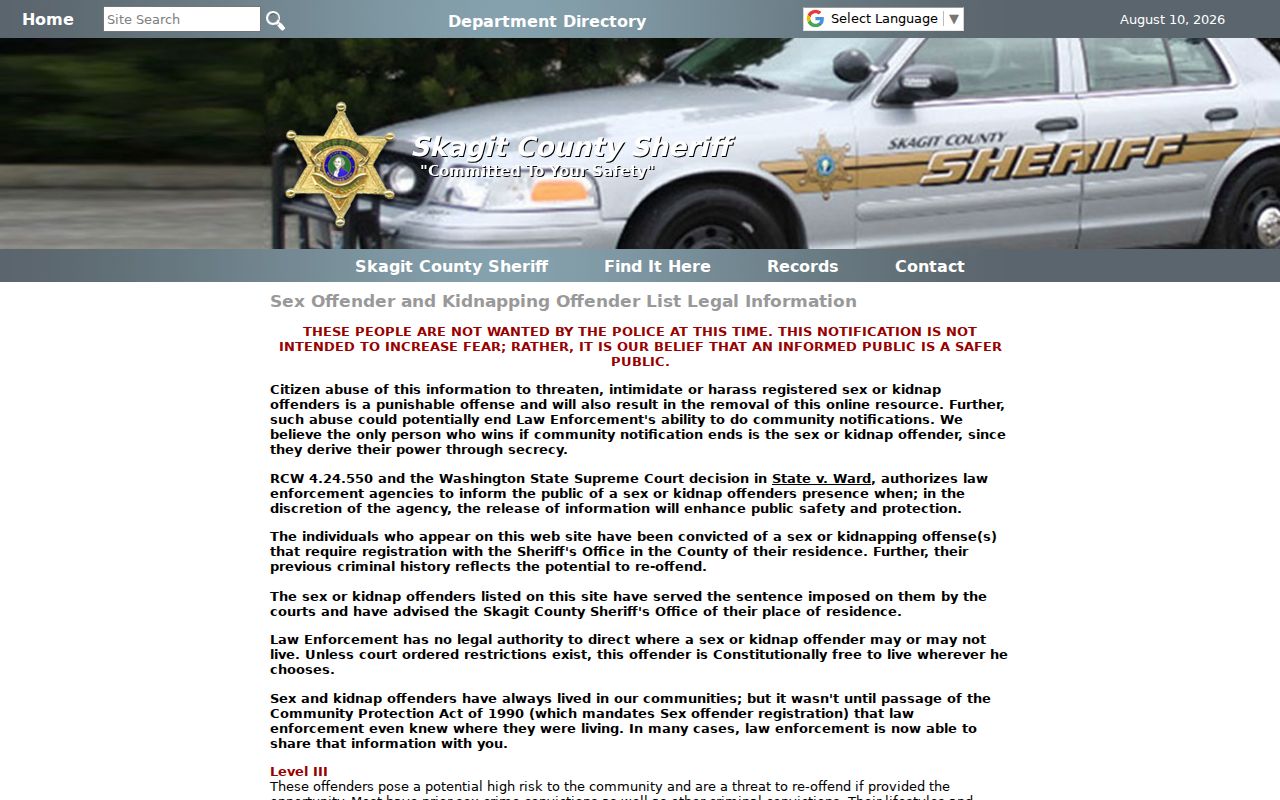
This local explanation matters because registration, risk classification, and public notice are related processes, but they are not the same legal decision.
Registration Requirements and Levels in Washington
Washington separates risk level from registration duration. Level I, II, or III describes the assessed risk used for community notification. Duration depends mainly on the qualifying offense and the rules in RCW 9A.44.140. RCW 9A.44.130 establishes registration duties, while RCW 9A.44.142 governs petitions for relief for qualifying people. A Level III label does not by itself supply the duration, and a Level I label does not mean a short term.
| Risk level | Public disclosure | Registration duration |
|---|---|---|
| Level I | Limited or request-based, with statutory exceptions | Separate offense-based analysis, not set by level |
| Level II | Broader notice to schools, child care, libraries, and relevant groups | Separate offense-based analysis, not set by level |
| Level III | Public-at-large disclosure | Separate offense-based analysis, not set by level |
| Typical duration rules | Not a risk level | Often 10 crime-free community years for a qualifying first Class C or identified offense, 15 for a first Class B, or indefinite for listed categories unless relief applies |
Skagit County Registry Duration Rules
A person reviewing a Skagit County profile should avoid turning its risk label into a time estimate. Under the Washington duration statute, qualifying first Class C or specified offenses generally require ten crime-free years in the community. A first Class B generally calls for fifteen. Adult Class A cases, repeat registrants, specified out-of-state, federal, or tribal cases, and sexually violent predators can have an indefinite duty unless the law allows relief.
The phrase “crime-free years in the community” is important. It is not always a simple count from conviction or release. Relief also is not automatic merely because a period has passed. RCW 9A.44.142 governs petitions and relief for qualifying people. The court record and registration authority are the proper sources for a particular duty.
For an out-of-state, federal, or tribal conviction, do not assume that the Washington term mirrors the source jurisdiction. The statute lists special categories, and the Sheriff applies current registration rules to the facts presented. A person seeking relief needs the controlling court process, not a change to a public profile made by a private request.
Skagit County Registry Across State Lines
NSOPW is the official U.S. Department of Justice layer for searching participating public registries across jurisdictions. It is most helpful when a person’s recent location is unclear, a family safety check spans more than Washington, or an address sits near a state boundary. Results still depend on what each jurisdiction is allowed to publish. A national “no result” is not a certificate that no duty or record exists.
The official NSOPW search interface shows the broader route available after a local Skagit County check.
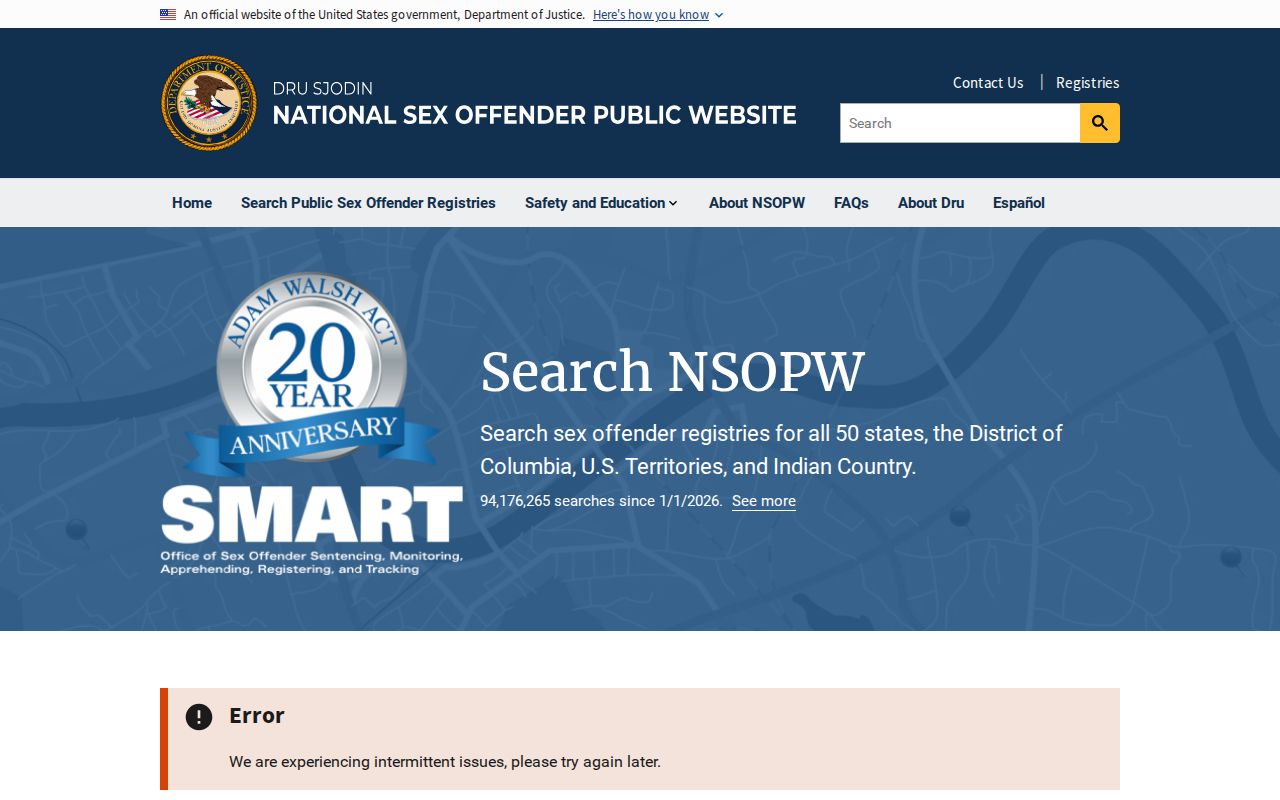
When NSOPW returns a Washington result, open the source jurisdiction’s profile and verify the current details there. For a Skagit registration issue, the Sheriff remains the local point of contact.
Skagit County Registry Is Not Warrants
Registration status and wanted status answer different questions. The Skagit County list records people selected for lawful public disclosure. The Sheriff cautions that inclusion does not mean a person is wanted. A profile also should not be read as proof of a new crime, current danger at a specific place, or permission to approach a home.
If the concern is suspected registration noncompliance, call law enforcement and state the facts. If the question is whether a warrant exists, use the relevant court and law-enforcement channels instead of the registry. The wider Skagit County criminal history overview explains why court, jail, statewide history, and registry systems cannot substitute for one another.
Lawful Use and Community Notification
Washington’s RCW 4.24.550 supplies the public-notification framework used by the Skagit County Sheriff. Registry information is meant for public safety, neighborhood awareness, and informed personal precautions. Use the listed facts to understand a location and, when needed, to speak with law enforcement. Do not publish private assumptions, attempt surveillance, or treat a past qualifying conviction as proof of current conduct.
Community notification grows with assessed risk. Level II notice may reach schools, child care providers, libraries, and relevant community groups. Level III supports public-at-large disclosure. Level I information is more limited, subject to statutory exceptions. Those rules explain why the local web list is selective rather than a full roster of all registrants.
Misuse is a crime: The Skagit County Sheriff warns that threats, intimidation, or harassment based on registry information are punishable under Washington law and may jeopardize continued public access.